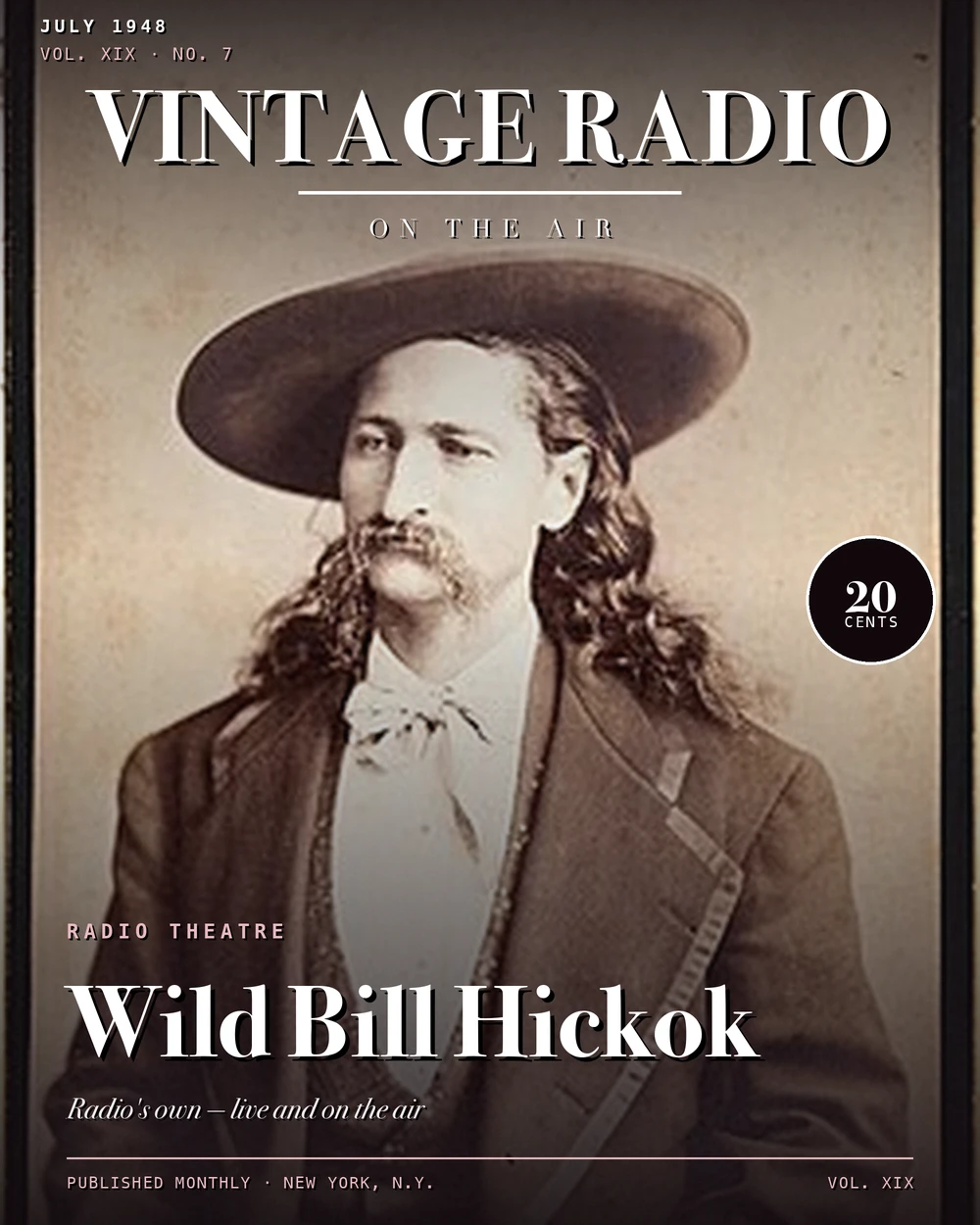
Wild Bill Hickok
How the Show Worked
What made Wild Bill Hickok unusual wasn't the stories — it was the setup. The show premiered on Mutual on May 27, 1951, running simultaneously as both a radio series and a television series with the same two lead actors playing the same characters on both. That kind of dual-medium operation was rare, and the fact that Guy Madison and Andy Devine anchored both versions gave the property a consistency that the producers of Hopalong Cassidy and The Cisco Kid — the models Wild Bill's format consciously borrowed — had rarely managed. Radio listeners and television viewers in 1951 were meeting the same Hickok and the same Jingles, just through different boxes.
The format itself was straightforward. Marshal Wild Bill Hickok, accompanied by his gravel-voiced sidekick Jingles B. Jones, rode into situations involving outlaws the scripts generally called "owlhoots," mixed it up with fisticuffs and gunplay, and punched out the ringleader by the final minutes. Jingles, who was written as stout enough to use his large belly as a weapon in fights, got his share of comic business while Hickok carried the heroics. Jingles also had the episode-opening catchphrase that listeners remembered: "The bravest, strongest, fightingest U.S. Marshal in the whole west!" Wild Bill's horse was Buckshot; Jingles rode Joker. It was a formula, and it worked the same way every week.
The show bore essentially no relationship to historical fact. The real James Butler Hickok was shot dead in Deadwood, Dakota Territory, and his time as Marshal of Abilene lasted little more than a year. None of that appeared in the series. The television version set the action at the fictional Fort Larabee in the 1870s and left it there.
On Mutual, and Who Was Paying for It
The initial Mutual run started as a 30-minute Sunday evening show at 7 p.m., and the first several months were sustained — meaning Mutual carried it without a sponsor. That changed on December 30, 1951, when Kellogg Cereals came on board. With the sponsor came a format change: the show shifted to 25 minutes and started airing three times a week at 5:30, rather than once on Sundays. The Kellogg arrangement also brought an extra layer to the broadcast — announcer Charlie Lyon doubled as a character called "Panhandle Jim" for the Corn Pops commercial segments. The Kellogg product had been called Sugar Pops when the sponsorship began in 1951; it was later renamed Sugar Corn Pops and eventually Corn Pops.
The first Mutual run ended December 31, 1954. The show returned to Mutual from July 17, 1955 through February 12, 1956, this time airing on Sundays at 5:30 under co-op advertising arrangements rather than a single national sponsor. Between the two Mutual periods and the simultaneous television run, the property was active throughout most of the decade. The radio series was categorized by researchers as a children's Western — which the Kellogg sponsorship made obvious enough, but the show's tone and pace confirmed it regardless.
Guy Madison
Guy Madison was born Robert Ozell Moseley on January 19, 1922, in Pumpkin Center, California. He was on Navy leave in Hollywood in 1944 when talent agent Henry Willson discovered him, gave him the name Madison, and put him in a bit part in David O. Selznick's Since You Went Away. Two years later, the starring role in Till the End of Time at RKO made him a recognizable film actor — which is what he was when he was cast as Hickok.
The Wild Bill role defined his American career. He received a special Golden Globe Award in 1954 and earned two stars on the Hollywood Walk of Fame in 1960, one for radio and one for television. After the Hickok run concluded, Madison moved to Europe and found a second career in Italian sword-and-sandal films, spaghetti Westerns, and German adventure pictures through the 1960s. He died of emphysema at Desert Hospital Hospice in Palm Springs on February 6, 1996, at age 74, and is buried at Forest Lawn Cemetery in Cathedral City, California.
Andy Devine
Andy Devine — full name Andrew Vabre Devine — was born October 7, 1905, in Flagstaff, Arizona, and grew up in Kingman. His instantly recognizable raspy voice came from a childhood accident: he fell while running with a stick in his mouth, which rammed through the roof of his mouth, and for nearly a year he was unable to speak at all. The voice that resulted became his defining professional trait.
Before Hickok, Devine had appeared in more than 400 films. He played the driver in John Ford's Stagecoach in 1939 alongside John Wayne, had roles in Romeo and Juliet (1936) and A Star Is Born (1937), and played the sidekick Cookie alongside Roy Rogers in roughly ten feature films. Jingles was a natural extension of what he'd spent years doing — the comic, loyal companion who lightened the hero's load and gave younger audiences someone to root for.
The Hickok role also led him into another medium. His popularity as Jingles is credited as a direct factor in his being offered the hosting role on the children's television program Andy's Gang in 1955, which he hosted through 1960 while the radio show was still in its second Mutual run. Later, he voiced Friar Tuck in Walt Disney's animated Robin Hood in 1973 and provided the voice for Cornelius the Rooster in Kellogg's Corn Flakes television commercials — a full-circle connection to the same company that had sponsored Wild Bill Hickok. Devine died of leukemia on February 18, 1977, in Irvine, California, at age 71. The main street through his hometown of Kingman is named Andy Devine Boulevard, and the town holds an annual Andy Devine Days celebration in his honor.
The Production Behind It
Paul Pierce directed the radio series. Richard Aurandt provided organ music, which gave the show its sonic texture in place of a full orchestra. The supporting cast was drawn from reliable Hollywood radio regulars — Ralph Moody, Howard McNear, Charlie Lung, Forrest Lewis, Jack Moyles, Clayton Post, Paul Frees, Will Wright, Barney Phillips, and Tyler McVey, with additional episode appearances from Dusty Walker, Fred Howard, Ted Bliss, and Tony Barrett.
The television side was produced by William F. Broidy Productions for the first 110 episodes. In 1957, Screen Gems — a division of Columbia Pictures — bought Broidy's assets, including 100 Hickok episodes already on film, and produced the final installments. The TV series ran eight seasons from April 15, 1951, through September 24, 1958, totaling 113 half-hour episodes. The first 100 were shot in black and white; the last 13, produced in 1957 and 1958, were in color. The series originated in first-run syndication, was subsequently picked up by CBS from June 5, 1955 forward, and also ran on ABC from 1957 through 1958. Allied Artists spliced multiple television episodes together into 16 feature films for theatrical distribution. The show was also exported to Australia during the late 1950s. Stunt doubles for Madison on the TV side included Fred Krone, Bill Catching, and Richard Farnsworth in successive periods. Main television writers included Maurice Tombragel, William Raynor, Sam Roeca, Joe Richardson, Warren Wilson, Peter Dixon, and the team of Robert Schaefer and Eric Freiwald.
What Survived
Researchers have catalogued 274 total episodes of the radio series, with approximately 268 known to exist in some form as of 2018 — a strong survival rate for a show of this era. A separate count puts the figure at 228 episodes total with 223 surviving, and the discrepancy reflects genuine uncertainty about the precise episode count rather than any definitive answer. For a children's Western built on a repeatable formula, the archive is remarkably complete — which means the full shape of what the show actually was, week to week from 1951 to 1956, remains documented.